

Can You Use Spray Oven Cleaner On A Self Cleaning Oven
Purchasing an oven with a self-cleaning program makes you wonder if there'due south a reason for you to keep your oven cleaning products. I mean, the self-cleaning oven will, allegedly, clean itself by running a self-cleaning plan.
This sounds an awful lot like my cat, who also has a cocky-cleaning program that he runs on a daily basis.
There's a big departure betwixt the way the self-cleaning program works compared to how an oven is cleaned traditionally, using cleaning products and other cleaning equipment.
So what's the difference and is at that place anything yous tin can use to a cocky-cleaning oven from the traditional style of cleaning an oven?
Y'all shouldn't employ oven cleaner when you clean a self-cleaning oven, there's no need for them and they may damage the oven's interior. The self-cleaning oven will instead blast high-temperature air or steam through its interior to remove hardened and burnt food. The self-cleaning oven tin can reach temperatures of 900-1000 degrees Fahrenheit when running a self-cleaning wheel, the heat will incinerate grime and leftovers without the use of strong chemicals.
Information technology's imperative that you only use either the cocky-cleaning cycle or a natural cleaning solution when cleaning an oven with a cocky-cleaning programme. Vinegar, baking soda, and lemon are not bad choices for a natural toxin-free solution that's somewhat effective.
Of course, these natural ingredients don't perform the same kind of magic that the caustic chemicals practise but they're still a good option for those who don't feel safe using strong chemicals in their household.
Why Can't You Utilise Oven Cleaner on a Self-Cleaning Oven?
The strong chemicals found in oven cleaners, primarily sodium hydroxide, are corrosive. These products are designed to pause downwards burnt food and make information technology easy to simply wipe it off the oven'south surface.
When used in a self-cleaning oven, the same product tin can harm the oven's interior and brand the self-cleaning system less constructive.
Having a self-cleaning is beneficial because information technology spares you from using toxic household cleaners – and those used in the oven are among the virtually toxic.
All of them aren't but a big portion of them comprise pretty stiff chemicals, which y'all'll understand when you read the product characterization.
Most manufacturers recommend that you vesture goggles and gloves to avoid straight contact with the cleaner. That'southward an indication of the chemical's backdrop and their strength.
If you even so insist on using oven cleaner in a self-cleaning oven, any leftover oven cleaner residue in the oven may release toxic fumes the next fourth dimension you're running the self-cleaning program.
These fumes tin damage the oven's interior, cause etching and discoloration of the oven liner, and make the self-cleaning bike less constructive.
Be restrictive when it comes to using abrasives or oven cleaners in your self-cleaning oven. All the same, there are exceptions to the rule that are fine to employ in a self-cleaning oven every bit they contain harmless ingredients in comparing to most commercial cleaners.
It's of import to sympathize why you should be careful when using stiff products but it's equally important to understand what kind of products you lot can and should employ if you choose to.
Preparation is partly the key to success and doing inquiry is definitely training. While cleaning an oven successfully isn't everyone's definition of success, rendering the oven useless as a upshot of a bad cleaning routine will about likely feel like a failure.
How Practise Y'all Manually Clean a Cocky-Cleaning Oven?
You may have read a bunch of manufactures that go confronting the use of the cocky-cleaning program, or you may not. Regardless, there's a proficient portion of users who have reported that their cocky-cleaning cycle has damaged the oven.
The most common parts that can start malfunctioning as the oven reaches such high temperatures includes the following:
- Major parts such as the locking mechanism
- Thermostat
- Fuses
- Electronic Boards
- Wires
- Contact Terminals
- Interior components such every bit the heating element
Why is it that the oven's own self-cleaning program can damage it's components?
I researched the issue and got in contact with a local who repairs kitchen appliances for a living and he gave me more insight on the topic. The get-go thing that I was informed of was the change in design that ovens have gone through since the early 2000s.
Remember the erstwhile days when the heating elements were exposed and mounted on the top and bottom of the oven'southward chambers? Recollect accidentally burning your hand while removing or placing a dish in the oven?
That barely happens anymore because these days the heating elements in an oven are hidden over the ceiling or underneath the floor. In addition to removing the risk of burning your easily, information technology also cuts out the scorching of dripping ingredients.
Simply equally great every bit it sounds, the hidden element characteristic comes at a cost that a few oven manufacturers yet struggle with and that's an disability to ventilate heat every bit the heating element is in a hidden compartment.
In improver to the negative impact that it has on the oven's power to circulate air, the subconscious compartment-installation also makes it more difficult to fix the heating elements if they were to terminate performance.
The trickier the reparation, the pricier the repairman will be.
Not being able to properly ventilate an oven that'south heated to 1000 degrees Fahrenheit (537 degrees Celsius) sounds like a real outcome to me and I understand why it can harm the oven's components.
Withal, according to manufacturers, the self-cleaning cycle is something that a lot of customers demand, and not beingness able to provide it will harm the companies.
This forces them to engineer something that's quite difficult to do flawlessly, and while they're improving as time goes, there are still risks involved with using the cocky-cleaning bicycle.
With that said, the risk of damaging your oven is quite small and can be minimized fifty-fifty further by running the cocky-cleaning cycle for merely an hour or two, rather than the full 4-6 hr bicycle.
What Cleaner Can You Use on a Self-Cleaning Oven?
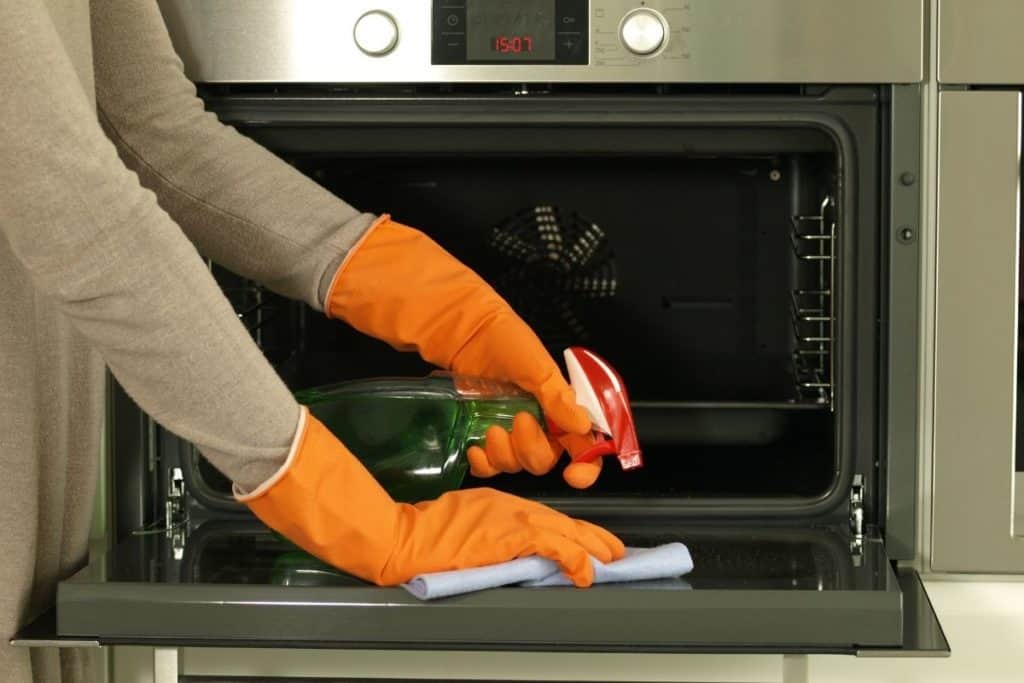
Our chief goal is to avoid an oven cleaner with harsh chemicals. The self-cleaning oven comes with a liner that's somewhat sensible to strong chemicals and will, if exposed to them, break downward after long plenty.
It can take years for the liner to pause down, but it can also happen within a couple of months. Regardless, using strong chemicals will accept a toll on the oven'southward liner and that'south more than enough to keep me from using strong oven cleaners.
Instead, y'all want something that'south uncomplicated and contains as few strong chemicals as possible. I've been using Piece of cake-Off Oven Cleaner for a while and I couldn't be happier with the results.
Like shooting fish in a barrel-Off contains no harsh chemicals, which makes it smoke-gratuitous, only it all the same provides the same kind of deep cleaning that a commercial oven cleaner containing strong chemicals would.
Beingness able to attain a somewhat like finish with a much simpler formula is something that makes Easy-Off stand out.
According to the company, Easy-Off is safe to apply in a self-cleaning oven only it was primarily designed for cold ovens. Information technology shouldn't exist used in convection ovens. You're not even required to wear gloves when treatment Easy-Off, which sounds like a strong indication that there are few corrosive chemicals to worry nearly.
That's what I would recommend primarily if you want to manually make clean a self-cleaning oven with oven cleaner. There is a second option that I can vouch for, which has similar qualities.
- Carbona Oven Cleaner: Similar to Easy-Off, Carbona Oven Cleaner has a simple, smell-free formula simply is still able to remove grease from an oven finer just minutes later it's been practical. It works very well for overall cleaning, spot cleaning, deep cleaning, tough stains, and baked in grease.
Tin can You Employ an Oven After a Self-Cleaning Cycle?
Equally you lot start the self-cleaning program, the oven door will lock to prevent y'all from opening it every bit the oven reaches incredibly high temperatures during the self-cleaning bicycle. The cycle and then takes a couple of hours depending on how dirty the oven is.
Once the cycle has finished the oven will turn off automatically just you won't exist able to open the door. Remember, the oven is however extremely hot and needs to cool downward earlier you tin can even consider using information technology.
When the oven has cooled down and reached regular baking temperatures, the oven door can in one case again exist opened. You should now have a clean oven at your disposal, ready to cook.
What Happens If You lot Leave Racks in a Self-Cleaning Oven?
I've mentioned it a yard times by at present simply considering the temperatures an oven reaches during the self-cleaning cycle, it wouldn't exist wise to get out the racks in the oven equally the self-cleaning cycle runs.
The racks will be exposed to extreme oestrus which can cause discoloration, warping, and cause additional harm to the oven as they may aggrandize or contract due to the estrus.
Remove the racks from the oven earlier you beginning the self-cleaning bicycle. Clean the racks manually instead. Soaking them in warm h2o and soap will go a long way.

Source: https://kitchensnitches.com/should-you-use-oven-cleaner-on-a-self-cleaning-oven/
Posted by: millergetelon.blogspot.com
0 Response to "Can You Use Spray Oven Cleaner On A Self Cleaning Oven"
Post a Comment